
︎HISTORY I
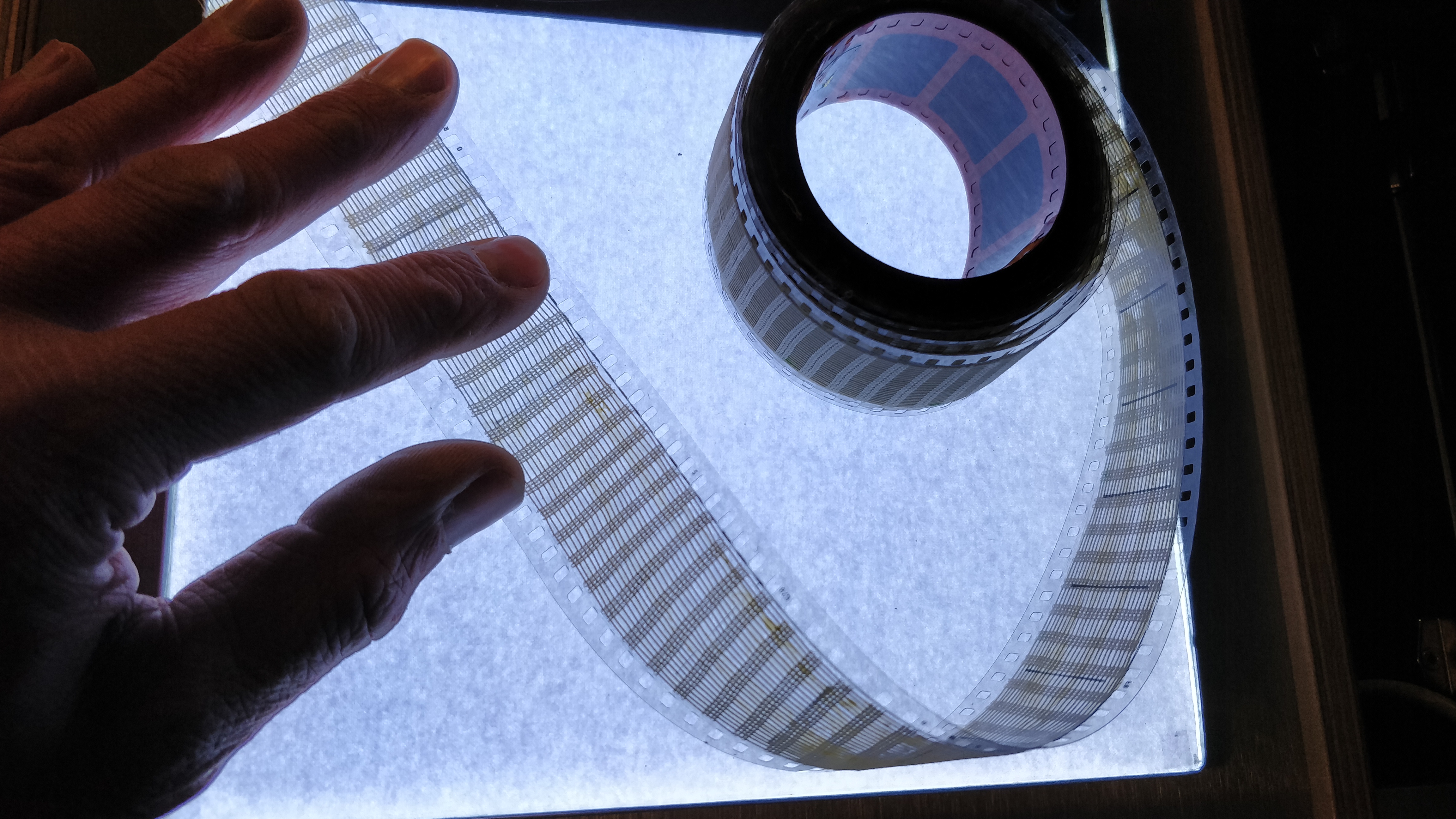
Pit Przygodda, “Gardine sing-sing”, 1992 (Film)
How it began : 1993
As a 25-year-old filmstudent at College of Art, Hamburg, I found my passion to use the optical soundtrack to create music by shapes and material. For tones with continuous pitch I was looking for material that showed regular patterns with a reasonable distance between single events to create notes in an audible range: So I collected several curtains and glued them on a 35mm blank film, as well on the picture frame as on the optical soundtrack: A variety of different density create different notes with different timbres, larger patterns like applied flowers create rhythms. The experimental movie "Gardine Sing Sing" (1993) was my first step on a long journey to the interferences of visuals and audio.I had been thinking for a really long time how the principle of the optical soundtrack can become a real time musical instrument: I started to dream of an instrument which offers the possibility to act directly within the visual space of an audio waveform, for example to move my hand inside the waveform: The moving shape of my hand, its silhouette, should be the outline of the sounding audio waveform.
Birth of the Light-Table : 2006
Again, it took many years to do the next steps. I couldn´t find a coder for the project, but then I heard about Pure Data and I could start testing some things myself. This led to a software prototype called "Videovox" which I presented at Superbooth 2016, Berlin.
Videovox : 2016
 The first software set-up as presented at Superbooth 2016
I was sure about the musical sensual power of the project, but at Superbooth 2016 only few people found their way to my booth. There were misunderstandings: some visitors thought it would be a VJ-software, and there was only little interest in software solutions right there.
SILHOUETTE “23” : 2019
Large, heavy, visionary and unfinished: The “23”.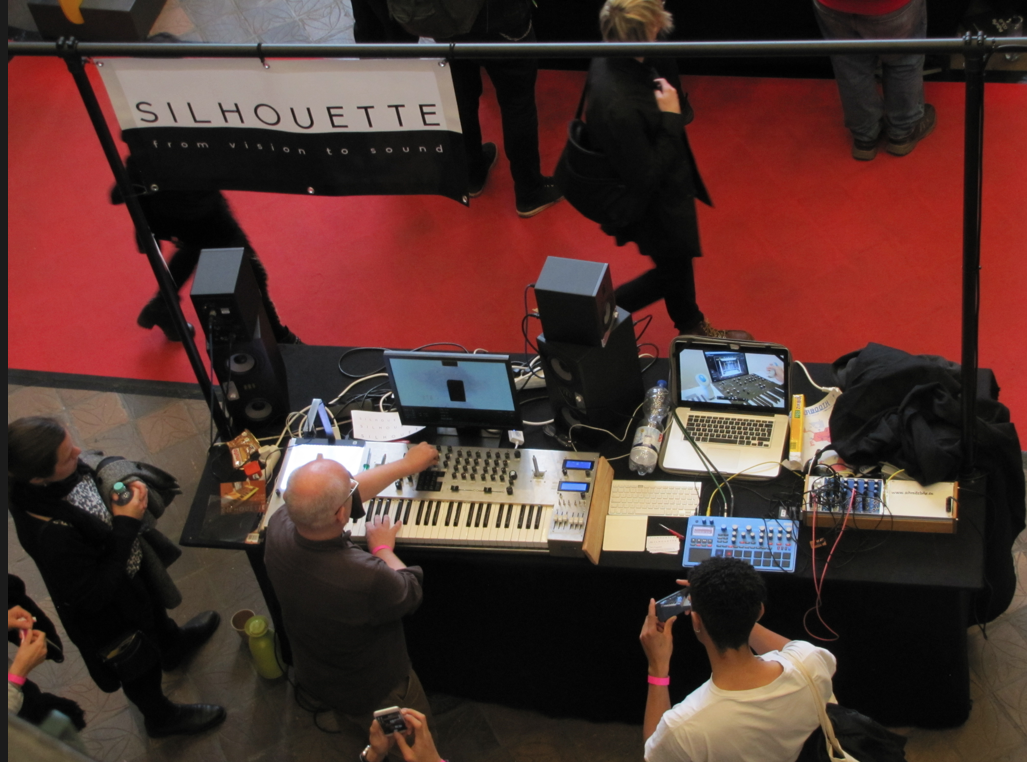
So I decided to change the name into "Silhouette" and to build a striking hardware nobody could ignore. It had 1 knob per parameter, 2 joy-sticks, a num-pad, 2x 4x16 characters displays, a 6 channel mixer, 49 keys, a webcam, a Mac Mini inside, a 4x4 audio interface, 2 analog filters, tons of weight, lots of bugs, and it never was finished:
I presented this huge prototype at Superbooth 2019. In fact it attracted much attention, especially the easy-to-use synthesis by hands and templates on the light-table, in front of the camera. So I realized to have made a giant step, but this prototype was not ripe for the market. So I used the Corona gap for the development of a smaller synthesizer, the SILHOUETTE EINS:
SILHOUETTE EINS : 2021

SILHOUETTE EINS
The SILHOUETTE EINS was presented at Superbooth 2021. Soon prospective buyers appeared. Now in 2024 there are 12 "EINS" out in the world.
PETG controller on Monitor
To reduce numbers of knobs, but not of parameters, I build a special transparent hardware controller which is mounted in front of a usual monitor which shows the GUI of the Silhouette system software:
 Controller on monitor (PET-G, Knobs, PCBs)
For the "EINS" 20 analog potentiometers and 21 buttons are fixed on a rack made of PCB boards. The controller addresses 4 pages of different function groups like audio/video parameters, modulation, LFOs and EGs, FX and wave editor. The different colored pages indicate the adjusted parameter values right behind the corresponding potentiometer as a number and a display circle. The SILHOUETTE SPORT will also use the PETG controller concept. But it uses 9 endless encoders. This concept also offers an open setting for further developments: New pages could easily be added or the whole software GUI concept could vary to target multiple goals of utilization concepts. Originally invented by the way, it soon became apparent that many people were fascinated by that combination of hardware touch, software remote and GUI visualization.
First thoughts about "the SPORT"
 The first sketches on paper, play with ideas and components
In the past few years, some people have asked for a smaller, more affordable SILHOUETTE. I started experimenting with smaller components. When I assembled the first prototype I realized how small it could be and that it might be attractive to make it portable (by the use of a reloadable battery on board). Transportability would be a special feature in combination with the implemented camera! The SPORT could become a hybrid of a portable video camera and a musical synthesizer! Wow!
"The SPORT" should be small and flexible in use. It should be able to use a lighttable, but it shouldn't need much space in the artist's studio. So I decided to build a demountable construction that located the synthesizer on top of the lighttable.
set upThe first set-up tests (MS surface pro), lighttable and controller set-up tests
Like the SILHOUETTE EINS it should have the PETG hardware controller mounted in front of the monitor. But it should be more reduced in knobs and elements and should have a kind of minimalistic and concrete elegance inspired by Braun Hifi equipment from the 60s. So I reduced the number of hardware knobs from 20 to 9 and decided to use mainly black and silver elements. While the upper side of the synth has a kind of cold metal-feel, the body of the housing is made of wood. In fact, this makes it feel more comfortable when it is being carried around.


Encoders, PETg housing, PCBs, touchscreen.
SILHOUETTE SPORT : 2024
"The SPORT" software is based on the same software concept as the "Silhouette Eins". It also has a PETG controller but with 9 knobs (half a "EINS" page). It has no keys (except a small touch screen monophonic 1-octave keyboard) and not necessarily needs to be combined with the light-table stand. It can be used stand-alone, or connected via MIDI to a DAW, a keyboard or a sequencer.
I soon found out that it is really fun to carry it around, filming the outside world, like with a video camera, filming from inside a driving car ... and transforming it into sound and rhythms at the same time! A wonderful connection!
Since the first presentation in public at Superbooth 2024 a very effective tool has been developed which was missing before in the SILHOUETTE synthesizers feature portfolio: a sequencer which is fed by realtime visuals:
And this is really one of the most exciting points: As the concept of an audiovisual synthesizer is quite unusual, there are still lots of features and ideas to be developed ahead! And, beside me, its the user community that figures out new goals for the future of the Silhouette synthesizers. I am open to and keen on influences from musicians, artists and others to push the evolution forward.
As the Silhouette software is programmed under the Pure Data environment, it is even possible for users who are familiar with it to develop their own modules. Or to go even further: to use the SPORT hardware for own audiovisual projects.
In 1980, when I was 12 years old, my parents bought my first synthesizer, a KORG MS-20.
About 6 years later I took part in a course for stop-motion-movie by Alexandra Schatz in Hannover. She showed films by Norman Mc Laren. This was the first time I became aware of the optical soundtrack. Norman Mc Laren painted directly on the soundtrack with pens to create sound, and so did we, - the participants of the course.
In 1992, I was 24 years old and a student for experimental-film at the art-academy-hamburg (germany). In the stop-motion-class of professor Franz Winzentsen we (the students) started working on blank-film-material to get an idea of the relationsship between time while screening and length of the material.
As a music-addicted I drove my attention to the sound-track on the film-material (it was 35mm-material with optical sound!) So I glued curtains on the film material even on the optical-sound-track, because I knew that the periodical structures of the curtains would generate steady tones, not noise. So it was. The film is called "Gardine Sing Sing" ("curtain sing sing").
["Johannes Przygodda" = "Pit Przygodda"]
Pit Przygodda, “Gardine sing-sing”, 1992 (Film with audio)
I have been on several media festivals in Germany, Switzerland and the Netherlands with "gardine sing sing", it was onArte-TV and it is part of the movie-compilation "Deutsche Experimentalfilme der 90er Jahre" by the Goethe-Institut. It is distributed by "Light-Cone", Paris, France.
︎︎︎ HISTORY II
︎︎︎ HISTORY III
︎︎︎ INSPIRATION/ THANKS
Pit Przygodda, “Gardine sing-sing”, 1992 (Film with audio)
I have been on several media festivals in Germany, Switzerland and the Netherlands with "gardine sing sing", it was onArte-TV and it is part of the movie-compilation "Deutsche Experimentalfilme der 90er Jahre" by the Goethe-Institut. It is distributed by "Light-Cone", Paris, France.
︎︎︎ HISTORY II
︎︎︎ HISTORY III
︎︎︎ INSPIRATION/ THANKS